
2026-10-19

When it comes to the critical realm of car safety, brake pads are an absolute must-have for dependable stopping force. With its long-lasting, dust-free, and high-friction formulas designed for various vehicles and road conditions, Jinli has completely transformed the industry as a top producer of innovative ceramic brake pads. Exceptional thermal stability, low dust, and noise reduction are the guiding principles of these Jinli brake pads, which meet the stringent noise and braking performance requirements of SAE J2521 and J2522. However, what is really going on underneath? Scanning electron microscopy (SEM) and energy dispersive X-ray spectroscopy (EDX) are two examples of the microscopy techniques that provide light on the microstructure of brake pads. These techniques show how the complex material compositions influence friction, wear resistance, and the pads’ overall lifespan. Jinli brake pads are the subject of this in-depth investigation, which uses state-of-the-art analysis to demonstrate their better engineering and the reasons they outperform conventional options in rigorous settings.
In order to maximize performance, it is crucial to comprehend the microstructure of the brake pads. These microstructured composites achieve a balance between controlled wear, mechanical strength, and heat dissipation by combining fillers, reinforcement fibers, binders, and friction modifiers into a multiphase structure. This means that Jinli’s ceramic-based brake pads can withstand temperatures up to 350°C, which is a significant improvement over older types of asbestos that fail at only 200°C. This is achieved by utilizing more than 20 precisely blended components. Everything from everyday travel to high-speed braking is informed by the interaction of these factors, which can be shown by analyzing SEM photos and EDX maps. Whether you’re a technician checking for consistency or an engineer looking to find new ideas, studying Jinli brake pads under a microscope can show you how to make braking systems that are safer and more efficient.
A Multi-Phase Miracle: Jinli Brake Pads’ Complex Composition
Jinli brake pads are unique in the market because of its ceramic formulations. These formulations include eight different specialized formulae that work together to make the pads last longer and produce less dust. Constructed from a complex mixture of materials that together create a heterogeneous microstructure, this design’s backbone guarantees constant friction coefficients regardless of the environmental stressors. Binders, reinforcing fibers, fillers, and friction modifiers make up the majority of the composition, according to reverse engineering investigations of comparable semi-metallic and non-asbestos organic (NAO) brake pads.
The composite is held together by binder, which is usually phenolic resin. It provides thermal stability and adheres to the backing plate. These resins are enhanced close to the metal contact in Jinli brake pads, making a strong bond that can resist shear stresses when braking. Aramid and steel wool are examples of reinforcing fibers that improve structural strength and heat transmission. Steel variations in semi-metallic designs increase mechanical strength for heavy-duty applications, while Aramid fibers add to the pad’s flexibility and noise reduction.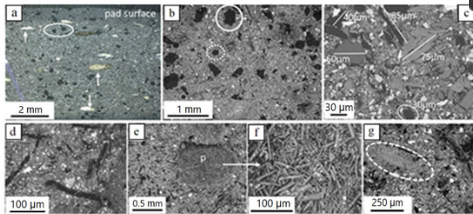
The function of fillers such as zirconium oxide (ZrO₂) and barium sulfate (BaSO₄) in controlling wear and friction is vital. The Jinli-inspired formulations can be analyzed using EDX to identify a minimum of sixteen elements, including carbon, oxygen, aluminum, iron, copper, zinc, sulfur, and barium. By absorbing vibrations, BaSO₄ particles stabilize the matrix and decrease aggressive wear. These particles can be seen as clusters of yellow in X-ray maps. At the same time, carbonaceous particles, which are examples of friction modifiers, make approximately 8-16% of the pad volume and can be anywhere from hundreds of micrometers (µm) in size to tens of nanometers (nm). Lubricants like this keep things from getting too hot and make sure everything fits together smoothly.
The distinctive elemental signatures of Jinli brake pads are further brought to light by state-of-the-art EDX scans. There are traces of aluminum, sulfur, and palladium, but the most abundant elements are oxygen (17.31 wt%), fluorine (17.41 wt%), barium (22.99 wt%), and sodium (12.54 wt%). Phenolic resin joins the matrix, creating a porous structure that helps dissipate heat, and graphite acts as the principal lubricant. Jinli pads are perfect for uses with a high ν (friction coefficient), thanks to the addition of hardness and chemical stability provided by K-titanate platelets and oxides/sulfides, such as Al, Si, and Fe compounds. Cleaner braking is becoming the norm thanks to this multiphase design, which improves friction performance while reducing emissions of airborne particles.
The scanning electron microscopy (SEM) images show the brake pads’ microstructure in breathtaking detail, revealing the uniform distribution of particles and fibers that give Jinli its performance advantage. The images are magnified up to 1500X. The compact and uniform design of the new Jinli brake pads is characterized by their crack-free surfaces with evenly spread granules. Under 500X magnification, scanning electron micrographs show a thin matrix with coarse (>10 µm) and ultrafine (<100 nm) particles scattered throughout, including phases that are rich in zirconium and so improve abrasion resistance.
By highlighting the distributions of individual elements, EDX mapping enhances these images. Hotspots of carbon in new pads show clusters of graphite, whereas signals of potassium and titanium show trace K-titanate platelets, which are plate-like structures that help the pad maintain solid contact with the rotor. Fourier Transform Infrared (FTIR) spectroscopy confirmed the presence of organic materials contained in phenolic resin, which gives the appearance of vermiculite fibers and aramid reinforcements as fibrous pockets or elongated voids. The significance of birefringent graphite-resin crystals in low-noise operation is further highlighted by polarized light microscopy at 200X.
When it comes to Jinli brake pads, digital microscopy uses methods like polarized light, differential interference contrast (DIC), and brightfield to check for composite uniformity. These technologies shed light on surface textures at magnifications ranging from 50X to 200X: brightfield records topography in its entirety, darkfield highlights more subtle elevations, and polarized views expose particles with anisotropy. What is the outcome? Images of the interaction between fibers and particles are so clear that they guarantee each Jinli pad will wear evenly and brake reliably.
In high-performance models of non-asbestos Jinli, SEM micrographs (e.g., Fig. 4 equivalents) reveal reduced porosity, increased hardness from dense packing, and reduced noise from balanced fillers. When it comes to off-road or towing, heterogeneous samples are the way to go because their bigger pores allow for better heat venting. Validating Jinli’s eight-formula portfolio, these SEM/EDX findings also direct adaptations for individual vehicle needs.
Microstructure changes due to friction and heat during braking, which is not a static process. Examining worn Jinli brake pads under a microscope reveals a process of transformative wear, where the surface goes from rough to smooth as time goes on. Using a scanning electron microscope (SEM) at 500X after use, we can see brown layers containing iron from the rotor transfer and braking traces, which are black streaks that span millimeters to tens of micrometers and cross the pad. Abrasion causes the formation of iron-enriched zones that are rich in both coarse (a few µm) and small Fe particles. The grey cast iron rotor is gouged by the harder ZrO₂ or Zr₂SiO₄ phases in the pad, which deposits Fe onto the surface.
Use causes a subtle change in the particle size distribution. The worn surfaces of the pads show signs of milling between the pad and rotor, as opposed to the new ones which have a wide range of particles ranging from huge carbonaceous flakes (~0.5 mm) to tiny ultrafines. Modulating friction, this “third-body” creation reduces direct metal-on-composite contact and increases pad life. Detached particles serve as an intermediary layer. Minimizing health dangers from airborne debris, Jinli’s dust-free ceramic pads have low-emission profiles, which means fewer particles with sharp edges (>350 nm) escape.
Another important process is differential wear. In order to expose the durable fillers and fibers, the softer phases, such as resins, dissolve first. Modifiers rich in Cu and Zn, such as FeCuS, disperse heat and prevent fading. With cellulose-enhanced fibers that effectively dissipate heat from hotspots, Jinli’s non-asbestos designs outperform asbestos pads in terms of temperature resistance, remaining intact up to 350°C. Furthermore, SEM-observed porous structures facilitate this by directing gases and debris, avoiding glazing, and guaranteeing uniform stopping power.
Brake pad microstructure examination is accessible using optical and digital microscopy in addition to scanning electron microscopy (SEM). JH Analytical-style analyses of Jinli brake pads employ 50X brightfield for mapping textures and 200X polarized light to highlight crystal orientations, illuminating the stress-induced alignment of graphite lubricants. Important for airflow in hot environments, darkfield at 50X highlights porous gaps.
Digital microscopes from Evident Scientific take this a notch higher with features like DIC-like blending modes, automated “best image” selection, and 3D-like depth in fiber distributions. The even spread that Jinli engineers for vibration-free braking may be confirmed by inspectors zooming into particle clusters. These XY-calibrated instruments make microstructure analysis accessible to more people, allowing workshops to check pad quality in real time.
Under the microscope, Jinli brake pads reveal a masterpiece of engineering: a ceramic superpower where each fiber, filler, and flake works in tandem to achieve unparalleled efficiency and safety. These analyses confirm that Jinli’s low-dust, high-ν pads are the market leaders by deciphering wear mechanisms, drawing on insights from SEM’s nanoscale revelations and EDX’s elemental blueprints. Knowing the microstructure of brake pads is becoming crucial as cars move toward electrification and autonomy. Jinli brake pads provide the micro-level control your roads require, supported by SAE-certified performance, making them an eco-friendly and long-lasting option for automotive experts. Discover the entire selection of Jinli products today and brake with assurance.


