2026-10-19

Brake pads, a critical yet frequently disregarded component, are increasingly being recognized as regulatory pressures and the popularity of electric vehicles (EVs) increase. These friction champions, who are unassuming, must adapt to the demands of eco-friendly standards without sacrificing performance. Jinli is a pioneering manufacturer that is revolutionizing the production of brake pads by employing innovative, low-impact methods. Jinli is not only reducing environmental damage but also setting a benchmark for the sector by incorporating renewable energy, cutting-edge materials, and rigorous pollution controls. This article delves into Jinli’s multidimensional sustainability strategy, which encompasses energy transitions and supply chain ethics. It illustrates how eco-conscious decisions result in superior brake pads that are advantageous to both the environment and the road.
 Energy
 is the starting point for the voyage toward sustainability. Traditional brake pad manufacturing is significantly reliant on fossil fuels for heating, machinery, and lighting, which exacerbates climate change by contributing to greenhouse gas emissions. Jinli reverses this narrative by implementing a comprehensive low-carbon energy transition that prioritizes renewable energy sources in order to reduce its dependence on non-renewable sources.
Distributed photovoltaic (PV) power generation projects are the core of this initiative. Jinli’s facilities are equipped with rooftop solar arrays that convert sunlight into clean electricity, thereby accomplishing a “self-consumption and surplus power to the grid” model. This configuration guarantees that the plant’s operations—including precision molding and the mixing of friction compounds—are powered by the excess energy, which is then fed into the local infrastructure to mitigate carbon emissions in other regions. In 2024 alone, these systems produced more than 500,000 kWh of solar power, which is equivalent to the averting of the combustion of 150 tons of coal or the establishment of 200 acres of forest. This renewable backbone stabilizes supply against volatile fossil fuel prices and reduces operational costs by up to 25% in brake pad production, where energy-intensive processes such as curing and testing require consistent power.
In addition to its solar initiatives, Jinli has implemented a complete overhaul of its factory illumination consisting of 100% LED energy-saving lamps. These energy-efficient lamps have a lifespan of 50,000 hours, which is five times longer than that of traditional fluorescents, and they consume 75% less electricity. The transition not only reduces annual energy consumption by 40,000 kWh but also reduces e-waste generated by frequent replacements. Imagining a production floor illuminated by a dazzling, flicker-free light, workers who are assembling NAO (Non-Asbestos Organic) brake pads are able to increase their visibility, thereby increasing safety and productivity, without the environmental impact of mercury-laden disposables.
Jinli’s stewardship of resources is completed by water conservation. Dramatic savings have been achieved through the widespread implementation of water-saving appliances, including low-flow fixtures, sensor faucets, and recycling systems. Jinli’s initiatives have resulted in a 60% reduction in water consumption, which is equivalent to the conservation of over 1 million liters annually, in a sector where cooling apparatus and cleaning rotors consume an abundance of water. This is not merely efficiency; it is a comprehensive strategy that is consistent with the global water scarcity challenges, thereby preventing the depletion of essential resources during brake pad manufacturing. Jinli demonstrates that low-carbon transitions promote innovation in sustainable automotive parts, reduce emissions, and enhance resilience by combining these elements.
Jinli is committed to the development of innovative materials that prioritize the planet, as product innovation is the foundation of environmental progress. The company’s hallmark brake pads utilize independently developed asbestos-free organic friction materials (NAO), thereby disrupting foreign monopolies and introducing a more environmentally friendly era to the industry.
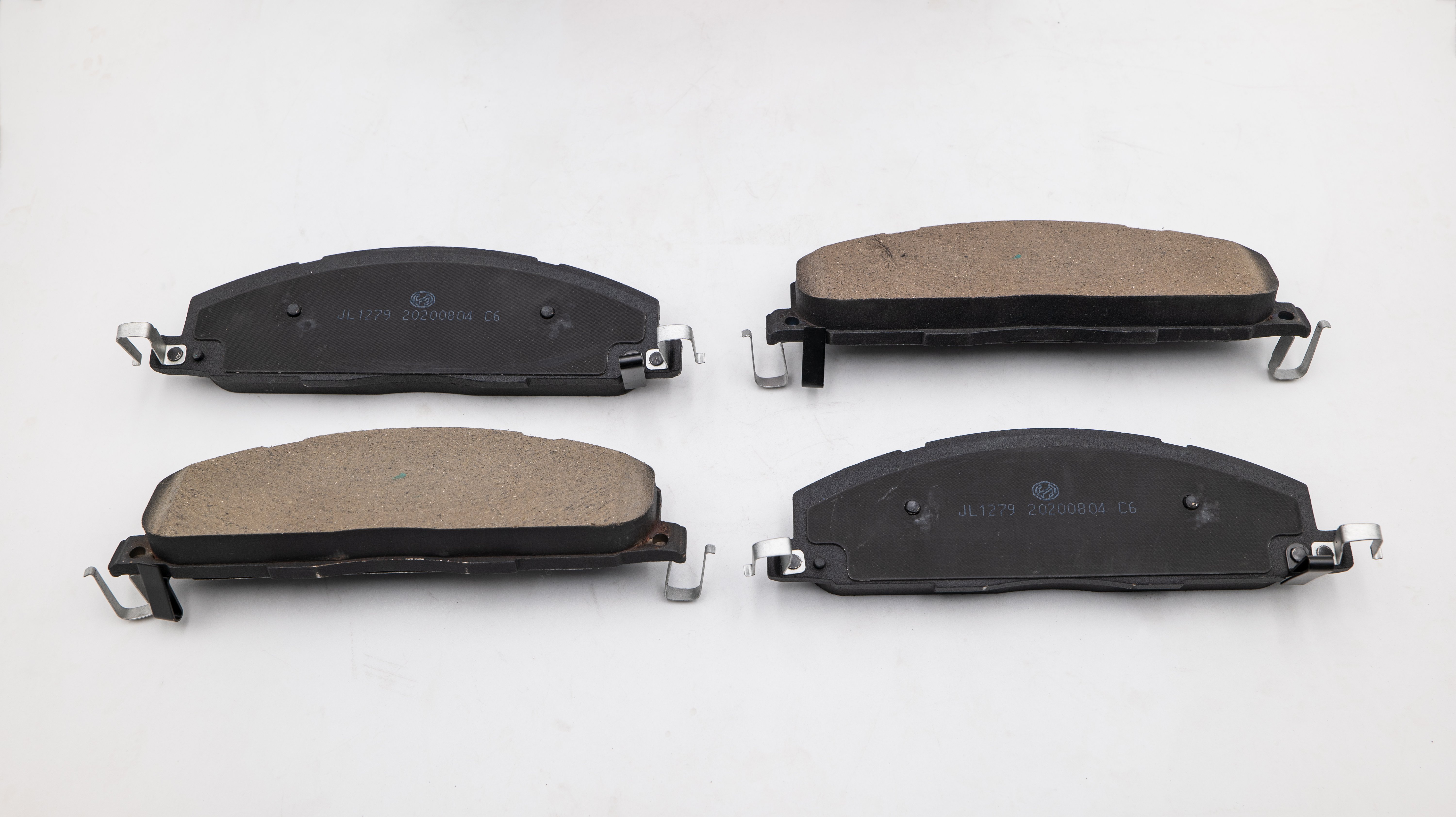
Due to its environmental persistence and carcinogenic dangers, asbestos, which was previously widely used in friction products for its heat resistance, has been prohibited worldwide. Jinli’s NAO formulations are capable of meeting the challenge by combining synthetic fibers, polymers, and lubricants to create compounds that provide exceptional performance without the associated risks. These eco-friendly brake pads are distinguished by their noiseless operation, dust-free deceleration, and extended lifespan—up to 50,000 miles, as opposed to the 30,000 miles of conventional options. Noise reduction is the result of optimized friction coefficients that reduce vibrations, resulting in a tranquil driving experience that is particularly well-suited for urban commuters and electric vehicles (EVs). In these vehicles, regenerative braking enhances sensitivity.
Production that is devoid of dust is a game-changing innovation. Abrasive particles that are emitted by conventional semi-metallic pads contribute to respiratory issues and ecosystem degradation by polluting air and waterways. Jinli’s ceramics and organics produce 90% less brake dust, which preserves the aesthetics of the wheel and reduces PM2.5 emissions. This is advantageous for communities that are striving to achieve cleaner air levels. Fewer replacements are necessary as a result of longevity, which reduces the extraction of raw materials and the amount of manufacturing waste. Each NAO pad conserves energy equivalent to 10 kWh per unit by avoiding the excavation of 2-3 kg of asbestos alternatives.
This innovation is not an isolated occurrence; it is supported by rigorous research and development, which includes dynamometer testing in accordance with SAE J2522 standards, to guarantee fade-resistant stops at temperatures as high as 600°C. Jinli enables manufacturers to comply with the rigorous EU REACH and U.S. EPA regulations by overcoming technological barriers, thereby establishing eco-friendly brake pads as a competitive advantage. Jinli’s materials are a prime example of how environmental design is the driving force behind market leadership and planetary health in a market that is expected to reach $20 billion by 2030, driven by sustainability demands.
Sustainability encompasses more than just energy and materials; it also encompasses the management of pollutants and the utilization of resources. Jinli is a leader in the transformation of prospective liabilities into assets through the implementation of clean production, waste valorization, and intensive land use.
Intensive land use optimizes factory footprints, thereby maximizing output per square meter. Jinli’s facilities utilize vertical integration, which involves automated warehousing and layered production lines, to manufacture 2 million brake pad sets annually on a mere 50,000 sqm, which is 30% less space than the industry average. This is consistent with the circular economy’s guiding principle of conservation through efficiency, which in turn reduces urban encroachment and habitat disruption.
Byproducts are converted into value through the utilization of waste resources. The internal recycling circuits are now fed by the scrap from pad trimming, which was previously landfilled. Phenolic resins are reclaimed for fillers, and metal shavings from rotor testing are melted for reuse. This closed-loop system recovers materials worth $500,000 annually, diverting 95% of solid waste from landfills. These advantages are further enhanced by the implementation of sophisticated pollution controls in clean production.
A two-stage innovation is employed in waste gas treatment: baghouse dust collection captures 99.9% of particulates, followed by activated carbon adsorption that neutralizes volatile organic compounds (VOCs). Emission concentrations of under 10 mg/Nm³ for particulate and 50 mg/Nm³ for VOCs are significantly lower than the national standards of 20 and 100 mg/Nm³, respectively. This technology safeguards the health of workers and the surrounding communities by preventing the formation of pollution during the curing of brake pads, where resins emit gases.
Through membrane filtration and evaporation, production effluent is recycled 80% into cooling towers, resulting in zero discharge. Domestic wastewater is treated with biological aeration to produce effluent that is 100% harmless, which is cleaner than potable water. The pollution hazards are significantly reduced by these measures, as Jinli’s water discharge is at 0%, compared to the sector’s average of 20%. Jinli demonstrates that high-performance brake pads can coexist with a low-impact footprint by incorporating resource efficiency, which not only complies with ISO 14001 standards but also inspires peers.
Forging a Green Supply Chain: Ethical Sourcing for a Sustainable Impact
The environmental ethos of a company is contingent upon the strength of its weakest link—the supply chain. Jinli has implemented a green supply chain management mechanism that integrates sustainability into all of its partnerships.
Supplier evaluations are now anchored by environmental performance, which is evaluated based on criteria such as ethical labor and carbon audits. Preferential contracts are awarded to high performers, while roadmaps for development are provided to laggards. This encourages green shifts in the upstream sector, as raw material providers transition to bio-based lubricants, resulting in a 15% reduction in embodied carbon.
Jinli prioritizes the use of recycled resources and ecological materials, sourcing 70% of its fibers from post-consumer textiles and 40% of its metal resources from scrap yards. This reduces the demand for virgin resources, thereby reducing the ecological impact of mining, which includes the loss of biodiversity, water contamination, and deforestation. Blockchain prototypes monitor NAO components from farm to factory, ensuring traceability through regular audits.
The agreement is sealed by transparency: Jinli releases annual social responsibility reports that provide environmental metrics, including a 25% reduction in carbon footprint since 2020 and Scope 3 emissions from suppliers. These disclosures, which are consistent with GRI standards, foster stakeholder trust and attract ESG investors. Jinli’s model ensures resilient production by mitigating risks such as raw material shortages from climate events in the brake pads arena, where supply chains encompass continents.
This comprehensive strategy generates ripple effects: the ecosystem thrives, costs are reduced through shared efficiencies, and partners innovate at a quicker pace. Jinli’s proactive approach ensures compliance and competitive moats as global regulations such as the EU’s Carbon Border Adjustment Mechanism loom.
Jinli’s endeavors extend beyond the confines of the factory, affecting the broader automotive industry. In electric vehicles (EVs), the importance of lighter, longer-lasting brake pads is paramount. NAO innovations enhance efficiency and range by 20% by reducing weight. Dust-free platforms are available for conventional vehicles, which contributes to the achievement of net-zero city objectives by reducing urban pollution.
If implemented on a widespread scale, Jinli’s strategy—which emphasizes renewable energy, pure materials, and zero-waste—has the potential to reduce the sector’s annual CO2 emissions by half. Challenges persist, such as the need to scale solar in cloudy regions and the difficulty of procuring ethical rares. However, Jinli’s adaptability is evident. The adoption of green technology is accelerated by collaborations with OEMs, such as those found in SAE forums, which promote a virtuous cycle.
Consumers also benefit: Eco-brake pads result in safer, quieter journeys and reduced lifetime costs. Demand for brands such as Jinli was stimulated by a 2025 Deloitte survey, which revealed that 68% of buyers prioritize sustainable vehicle parts.
Jinli brake pads are the ultimate combination of braking excellence and environmental stewardship in the pursuit of sustainable mobility. Crafted from exclusive NAO and ceramic compounds, they provide dust-minimal, whisper-quiet stops with unparalleled longevity. They have been certified under E-mark, AMECA, NSF, and IATF 16949 and have been validated through SAE J2521 noise and J2522 performance tests on advanced LINK 3900 dynamometers.
What distinguishes Jinli? In extreme conditions, superior heat dissipation prevents deterioration, while low-VOC production guarantees a more environmentally friendly lifecycle. Rotor wear is reduced by 40% and service intervals are extended by utilizing eight specialized mixtures that are designed for EVs, SUVs, and sedans. In addition to the specifications, Jinli’s solar-powered facilities and zero-discharge ethos ensure that each pad you implement contributes to a healthier planet by reducing emissions, waste, and maximizing potential.
Elevate your driving experience with Jinli: the intersection of sustainability and stopping power. Join the green braking revolution today by exploring the complete selection at jinli.